COFFEE BOOKSHELF

who wants to understand more about coffee this is the book to have

This is the first book to chart the coffee production of over 35 countries
Encompassing knowledge never previously published

-HENRY BUI-

16/04/2026

There is a point where coffee stops being a preference—and starts becoming a question. Not about whether it tastes good, but about why it tastes the way it does. That shift is subtle, but once it happens, you don’t really go back. And it’s precisely at that point that The World Atlas of Coffee becomes relevant—not as a guide, but as a framework to start seeing coffee differently.

Author: James Hoffmann – A Practitioner’s Perspective

Understanding this book begins with understanding its author. James Hoffmann is not only the World Barista Champion 2007, but also the founder of Square Mile Coffee Roasters—a name that carries weight in specialty coffee.

But what matters more is how he approaches the subject. There is no attempt to impress, no unnecessary complexity. The writing is structured, deliberate, and grounded in practice. It reflects a mindset that values clarity over performance—something that becomes increasingly rare in how coffee is talked about today.

A System, Not Just a Story

The book does not begin with brewing, because brewing is only the surface. Instead, it moves backward—to varieties like Typica, Bourbon, Geisha; to altitude, climate, and processing methods.

What emerges is not a collection of facts, but a system. Flavor is reframed—not as something subjective or abstract, but as the outcome of a series of decisions. Farming, harvesting, processing—each step leaves a trace, and the cup becomes a result rather than a mystery.

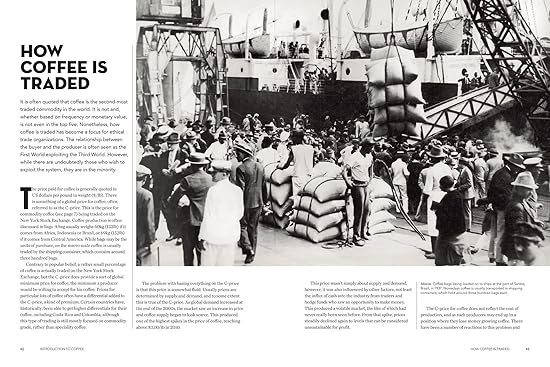
At the same time, coffee is not isolated from its context. The book expands into history and economics, acknowledging how coffee has been shaped by trade, colonization, and global demand. It’s a reminder that what feels personal in a cup is often the product of something much larger.

The book itself is structured in three parts—starting with the fundamentals of coffee, moving into brewing, and culminating in the atlas section. This progression is intentional: you don’t just learn how to make coffee, you learn how to place it.

The Atlas – Reading Coffee Geographically

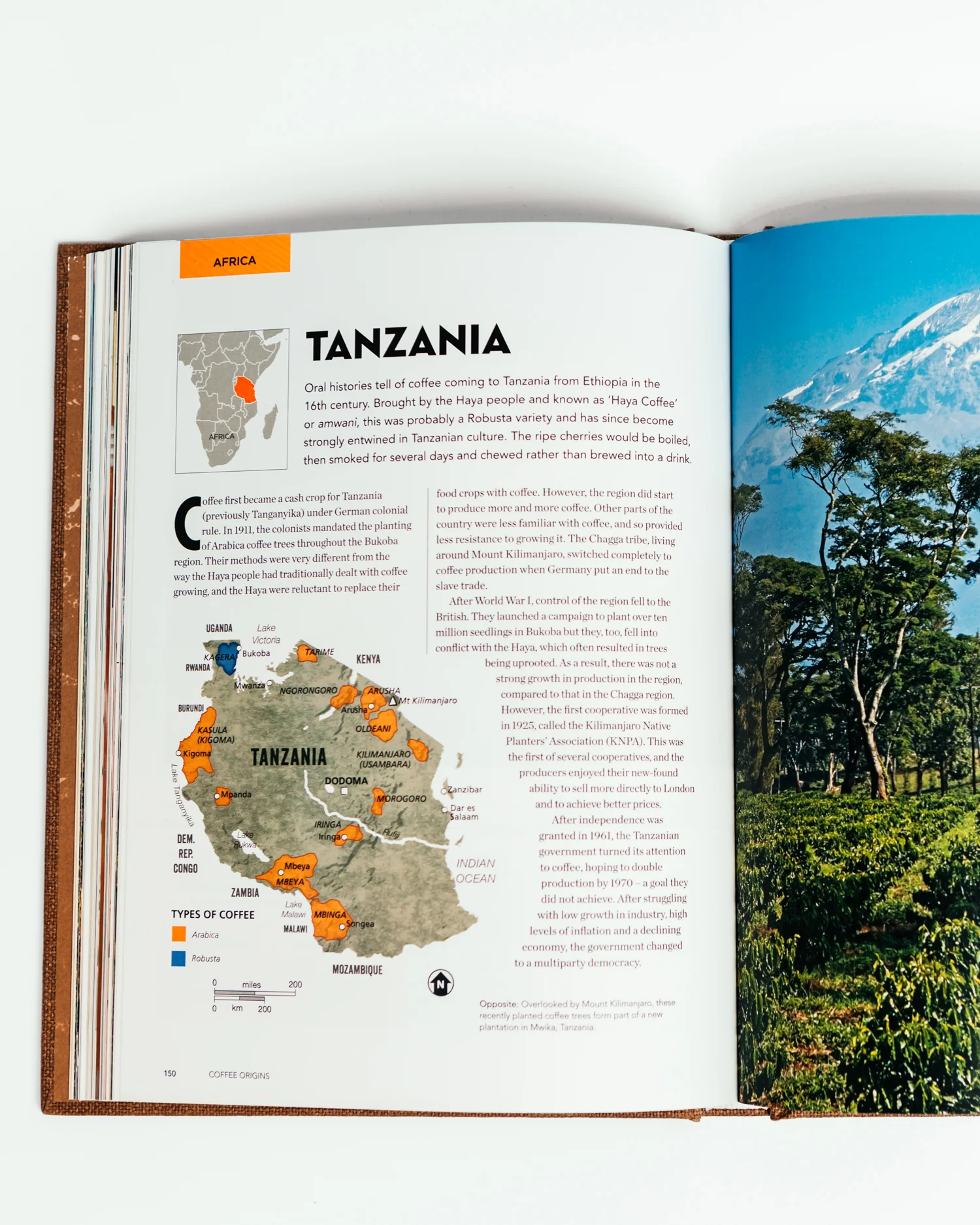
The maps are where the book becomes most precise. Not decorative, but analytical.

Each origin—Brazil, Ethiopia, Colombia, Vietnam—is presented as a system of conditions: geography, harvest cycles, processing methods, and typical flavor profiles. The value is not in memorizing these details, but in recognizing patterns.

While coffee is grown in over 70 countries, the book focuses more closely on the major producing regions—those that shape the global profile of coffee today.

Over time, you stop asking “what does this taste like?” and start asking “why does it taste like this?” The atlas doesn’t give you answers—it gives you a way to think.

Structure, Visuals, and Use

The book is carefully constructed. Layout, diagrams, and images are functional—they reduce complexity rather than add to it.

The brewing section toward the end is consistent with the rest of the book: minimal, precise, and grounded. It doesn’t try to cover everything, only what matters. Enough to establish a baseline, without overcomplicating the process.

Coffee Within a Larger System

One of the more important aspects of the book is what it chooses not to ignore. Coffee is presented not only as a product, but as part of a system involving labor, trade, and sustainability.

Fair trade, environmental impact, and economic imbalance are not positioned as side topics. They are embedded into the structure of understanding coffee itself. The implication is simple: you cannot fully understand the cup without acknowledging the system behind it.

It suggests that understanding coffee is not just about improving taste, but about recognizing the conditions that make that taste possible.

PROS & CONS

Pros: The book is structured with clarity, moving from fundamentals to broader systems. It avoids unnecessary complexity while still maintaining depth. Visual elements support understanding rather than distraction.

Cons: The density of information may feel heavy if approached casually. Certain data points may shift over time, but the underlying framework remains stable.

This review is based on a synthesis of publicly available information and independent research

By the end, what changes is not how much you know, but how you see. Coffee is no longer approached as a finished product, but as a process—one that extends beyond the cup.

You begin to notice more. To question more. And eventually, to understand that what appears simple is rarely simple at all.

If you’re looking for quick answers, this may not be the right book. But if you’re willing to stay with the questions a little longer, this is the kind of book you don’t really finish—you return to it.

Let the music settle in—and fall into the pages

FDH

Notes Café began with a simple and deeply personal curiosity. Rather than merely reviewing cafés or describing flavors in a subjective way, we chose to explore coffee through a wider lens — looking at the culture, the people, and the everyday stories that exist around the coffee bean.

Through carefully selected articles, Notes Café hopes to help readers see coffee from a deeper perspective — not only as a drink to enjoy, but as a reflection of culture, place, and the rhythm of everyday life behind every cup.

The content at Notes Café is shaped by real-life experiences and the ongoing exploration of people who share a passion for coffee.

Notes Café offers a slower, deeper perspective on the world of coffee — where knowledge, stories, and cultural experiences come together around every cup.

Copyright © 2026

Leave a Reply

Your email address will not be published. Required fields are marked *